
Studie «Sicherheit 2026»
[MILAK ETH, 26.05.2026, Tibor Szvircsev Tresch et al.]
Die diesjährige Studie zur aussen-, sicherheits- und verteidigungspolitischen Meinungsbildung der Schweizer Stimmbevölkerung zeigt unter anderem: 50% sind der Ansicht, dass Auslandeinsätze der Schweizer Armee zur Sicherheit der Schweiz beitragen. Die Zustimmung zu einer Annäherung der Schweiz an die NATO ist um 3 Prozentpunkte auf 56% gestiegen. Nur noch 25% befürworten die Abschaffung der Wehrpflicht – der tiefste Wert seit 1983.
Link: https://css.ethz.ch/ueber-uns/CSS-news/2026/05/studie-sicherheit-2026.html
The Rise of AI Drone Warfare in Ukraine
[YouTube, 06.06.2026, War Archive]
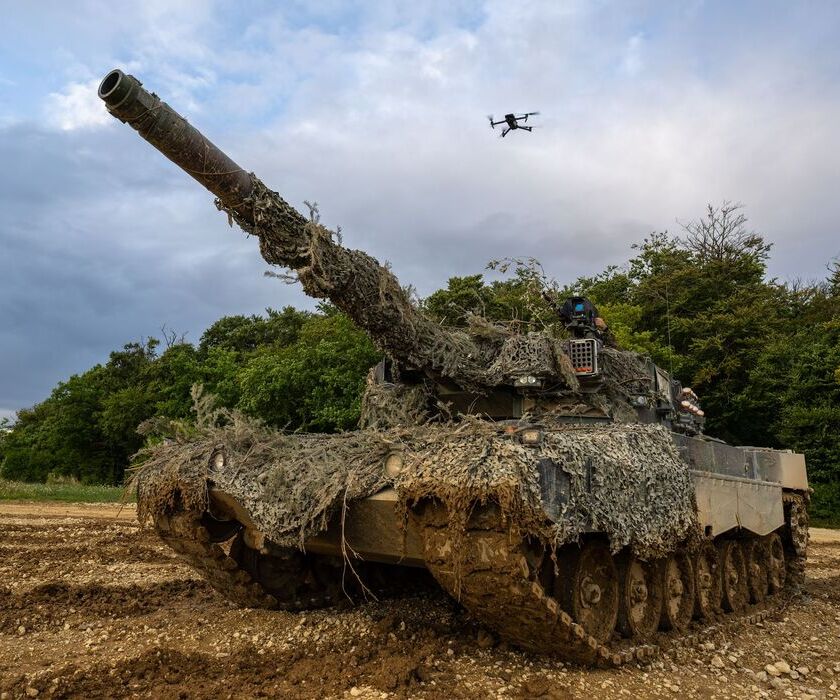
Over the past few years, both sides in the Russo-Ukrainian War have adopted unmanned aerial systems (UAS) extensively at the tactical level. Deep strikes, including attacks on Russian oil refineries, also have strategic effects. Ukraine now fields improved fixed-wing drones that use AI for terminal guidance, enabling them to reach their targets even under electronic-warfare disruption. Combined with degraded Russian air defence capabilities, this means that Ukrainian medium-range strikes increasingly generate effects at the operational level. Protecting military logistics under similar conditions is therefore a pressing question for many armed forces.
Link: https://youtu.be/wjZhQdTGFno?si=JXjHbE4jVinugpud
Beyond FPVs: Learning the Lessons of the Ukraine War, All of Them
[Modern War Institute, 08.10.2025, Sam Scanlon]
Scanlon argues that the war in Ukraine is neither a crystal ball for future warfare nor irrelevant to it. While debate often remains fixated on aerial drones, innovation has spread across domains: ground robots increasingly perform routine and high-risk tasks, and maritime drones have evolved rapidly, as demonstrated by Ukrainian naval drones downing Russian fighter aircraft in May 2025. He further argues that low-cost deep-strike capabilities require equally low-cost defensive solutions. Overall, the article makes the case that armed forces must learn and adapt quickly enough to out-innovate a changing adversary.
Link: https://mwi.westpoint.edu/beyond-fpvs-learning-the-lessons-of-the-ukraine-war-all-of-them/
Will, Cohesion, Resilience, and the Wars of the Future
[CSIS, 16.09.2025, Daniel Byman]
This article by the Center for Strategic and International Studies reasons that modern conflicts depend as much on political unity and societal resilience as on military power. Drawing on Ukraine and the Middle East, it highlights three imperatives, namely building public trust to strengthen societal resilience, reinforcing alliance cohesion through coordination, and countering divisive disinformation.
Link: https://www.csis.org/analysis/chapter-2-will-cohesion-and-resilience
The Russian «Firehose of Falsehood» Propaganda Model
[RAND, 11.07.2016, Christopher Paul, Miriam Matthews]
Already having been published 10 years ago, this article examines in detail how modern Russian propaganda works, and why its inherent contradictions are not a flaw but rather a core feature. Paul and Matthews argue that people’s mental resilience and awareness are key in lowering their vulnerability to propaganda, saying “[D]on’t expect to counter Russia’s firehose of falsehood with the squirt gun of truth. Instead, put raincoats on those at whom the firehose is aimed”.
Link: https://www.rand.org/pubs/perspectives/PE198.html
Bevölkerungsschutz im bewaffneten Konflikt: Ländervergleich zu Schutzbauten und Evakuierungen
[CSS ETH, Mai 2026, Leonard Schliesser]
Zivile Resilienz ist ein zentraler Bestandteil militärischer Verteidigungsfähigkeit. Um die Wiederausrichtung des Schweizer Bevölkerungsschutzes auf militärische Konflikte zu unterstützen, vergleicht diese Fallstudie den aktuellen Stand ziviler Schutzbauten und Evakuierungskonzepten in Finnland, Deutschland, Polen und in der Ukraine. Besonders hervorgehoben werden dabei das umfassende Sicherheitsmodell Finnlands, das Tempo im Polnischen Bevölkerungsschutz sowie die forcierte Improvisationsfähigkeit im Ukrainischen Bevölkerungsschutz. Auf der verlinkten Website können Sie die komplette Studie als PDF-Datei herunterladen.
À propos de « Update Conduite »
Le « Update Conduite » est une rubrique récurrente de la newsletter Leader’s Digest. Cette newsletter est le fruit d’une coopération entre le Leadership Campus de l’Armée suisse et les études conduite et communication de l’Académie militaire à l’EPF de Zurich. Si vous n’êtes pas encore abonné au Leader’s Digest, vous trouverez de plus amples informations ainsi que le formulaire d’inscription en cliquant sur ce lien. Si vous découvrez des choses intéressantes à lire sur Command, Leadership ou Management, nous serions heureux que vous les partagiez avec nous. Nous serions heureux de recevoir des conseils pour le prochain numéro du Leader’s Digest par leadersdigest@leadershipcampus.ch.
Nouveau : tous les articles parus jusqu’à présent dans la rubrique « Update Conduite » sont désormais disponibles dans les Archives Update Conduite.